
SAN BENEDETTO DEL TRONTO
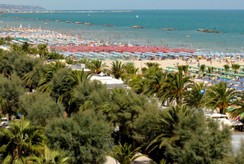
In the current provincial structure, San Benedetto is a major economic center and the second largest urban center after Ascoli Piceno. It would be wrong to think of this seaside town as devoid of history. On the contrary, it is interesting to understand the roots of its birth and evolution in order to understand its maritime roots today, which must have come from afar. The raids, emigrations, immigrations, and relationships with trans-Adriatic populations are all elements of a history that helps us understand how, over the centuries to come, this small village experienced such significant expansion, increasingly taking on the distinctive features of an "open city," accustomed to trade and commerce, a point of reference for many municipalities in the Piceno area. The now safer and easier coastal road system made San Benedetto an important hub between the Papal States and the Kingdom of Naples. New job prospects, and the sea as a means of sustenance, pushed the community entrenched in the small village to move towards the sea in the 19th century, thanks in part to land reclamation projects that had made unhealthy and dangerous places habitable, reclaimed from the sea. Houses built of straw and clay were the first homes of the fishermen. By 1851, the population numbered 5,351. In 1863, the Adriatic railway line was built, representing a historic moment for the entire area. During the same years, the first beach resorts opened, declining San Benedetto's vocation as a tourist destination. In 1896, a royal decree granted San Benedetto the title of Tronto.
GROTTAMMARE
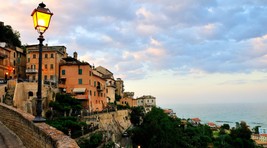
Grottammare overlooks the Adriatic coast, nestled amidst the greenery of its pine forests, orange groves, and palm trees, with its golden beaches and the clear blue sea. The clean waters, the fine sandy shoreline, the enchanting views of the old town, and the lush vegetation create a tapestry of colors and forgotten scents that make our town unique. The combination of these elements, along with the functionality and quality of its services, have earned Grottammare the prestigious Blue Flag award from the F.E.E.E. (Foundation for Environmental Education in Europe). The European Union awards this award annually to municipalities that stand out for their impeccable water quality, meticulously maintained street furniture, highly functional purification systems, and excellent tourist services. An important recognition which over the years has been joined by other prestigious titles such as the 3 Sails of the Touring Club's Blue Guide and the inclusion of the old farmhouse, clinging to the hill, among "The Most Beautiful Villages in Italy". Grottammare stands out among other towns on the Adriatic coast for its privileged location, surrounded by lush vegetation, sheltered to the west by gentle slopes and lapped by the sea to the east. This unique location allows it to enjoy a mild climate year-round, allowing the numerous Phoenix canariensis palms, native to the Canary Islands, to thrive alongside the orange trees, which adorn the Grottammare skyline and constitute one of the area's most notable features. It's no coincidence that two orange trees feature prominently in the municipal coat of arms: they flank a crenellated circular tower that represents the fortified circuit of the city walls, typical of medieval towns, and recalls the ancient lighthouse of the city port.
OFFIDA
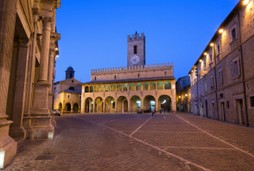
The Town Hall (11th-12th centuries), one of the most beautiful in the region, boasts a splendid façade with a row of evocative swallowtail battlements. Looking up, the Clock Tower, today a striking sight in its beauty, was once used by the Offida people as a prison for those condemned to death. The elegant 15th-century portico on the ground floor and the upper loggia supported by a row of travertine columns on the first floor complete the façade of the Town Hall. Not far from the town, imposing and proud, surrounded by a magical atmosphere, the austere guardian of the secrets and virtues of this town, the Church of Santa Maria della Rocca is tangible proof of the elegance and splendor with which the Benedictine monks surrounded themselves. Built in Romanesque-Gothic style, it is the most significant architectural monument. It was built in 1330 on the foundations of a Lombard castle. Offida shows its wildest and most playful side during the carnival celebrations. The Offida Carnival has something sacred, perhaps even mystical, about it, as it is experienced and experienced by the people of Offida. Preparing for Carnival means preparing for a ritual, entering into a state of mind that accompanies the people of Offida not only when they put on the "guazzarò," the typical Carnival costume, but long before. Two of the most popular events are "Lu Bov Fint," celebrated on Fat Friday, and "Vlurd," celebrated on Fat Tuesday. Offida, peaceful in its squares and churches, preserves and passes on, in the shade of its alleys, on the doorsteps of its homes in spring, thanks to the admirable skill of its women, the ancient tradition of bobbin lacemaking.
ASCOLI PICENO
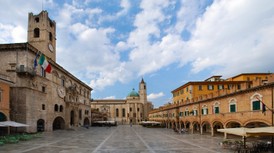
Ascoli is always a surprise, an unexpected encounter. Wonder is the most common feeling experienced by those who pass through its gates and bridges for the first time to enter the city of a hundred towers. The city's origins are very remote; the people of Ascoli like to say they are older than Rome, and this is probably true considering that the first settlers may have been young Sabines from Lazio, guided on their journey by a woodpecker, a bird sacred to Mars. "Piceno" is thought to be the etymological derivation of "Picus," meaning woodpecker. The symbol of Ascoli is, in fact, the woodpecker. We recommend starting your visit in Piazza Arringo. In ancient times, popular assemblies were held in the square, which is likely where its name comes from. A few meters from Piazza Arringo is Piazza del Popolo, whose beauty makes it one of the most evocative in Italy. The local stone dominates, that white travertine that time makes unique. And so, the imposing façade of the Palazzo dei Capitani is at its best next to the refined Caffè Meletti, all ornate and resplendent. This square is a play of references, from one century to the next, from one story to the next; just pause on the mullioned windows, on a wall plaque with an inscription. You enter the square and speak informally, turning and turning, looking around, curious and enthralled, until you understand that the proportions, the backgrounds, the openings, the views, are there for you and you for them, so that for a moment, time is no longer time, but something akin to an embrace. Historic city centre, meeting place and charm, Piazza del Popolo owes its current architectural homogeneity to a far-sighted and unitary project of reorganisation of the space implemented in the sixteenth century, the century of divine proportions which replaced a pre-existing disuniform agglomeration of hovels and artisan workshops.
RIPATRANSONE
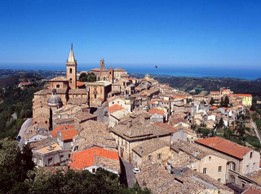
This splendid village, perched high on the hills, was given the nickname "the bastion of Piceno" in the 16th century, due to its unique location making it an exceptional watchtower as well as a nearly inaccessible place. The imposing Town Hall, built in the 13th century and completely rebuilt in the 17th century, now houses the Library and the Archaeological Museum, which houses over three thousand pieces. The Civic Art Gallery is located inside Palazzo Bonomi-Gera and features artists from various eras, with works by contemporaries such as Pericle Fazzini and Arnoldo Ciarrocchi, and panel paintings by Vittore Crivelli (15th century) and Vincenzo Pagani. The centuries-old history of this town's inhabitants is celebrated every year with one of Italy's oldest fireworks displays, the Cavallo di Fuoco (Horse of Fire). Its origins date back to 1682, when it was first celebrated on May 10th, the date of the coronation of the Madonna di San Giovanni. On the first Sunday after Easter, a sheet metal horse, atop which beautiful fireworks are mounted, is led through the town. When the skilled hands of the fireworkers begin the show, the fiery horse is paraded around Piazza Condivi and beneath the Duomo, providing thrilling moments not only for all the residents of Ripani but also for the crowds of tourists who flock to the eagerly anticipated event every year.
FERMO
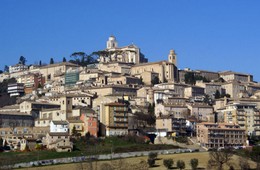
Fermo's origins are ancient, as evidenced by its Roman-era cisterns and numerous monumental buildings, including the splendid Pazza del Popolo, home to the Palazzo dei Priori and the Municipal Art Gallery, which boasts important Venetian school paintings. Its Cathedral, dedicated to the Madonna dell'Assunta, stands atop the hill and is visible from all directions, offering views of the surrounding countryside and the sea. Its asymmetrical façade makes it an unmistakable landmark. Also worth visiting are its ancient library, the Church of San Francesco, Palazzo Fogliani, and all its charming narrow streets. The characteristic antiques market, held every Thursday in July and August, is also not to be missed, and the famous Palio dell'Assunta on the 15th of August is a must-see. It is packed with side events, including parades in period costumes and flag-throwing and drumming performances throughout the week preceding the horse race.
ACQUAVIVA PICENA
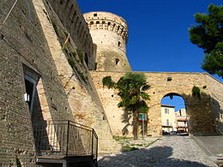
Known for its imposing fortress, Acquaviva Picena is a splendid medieval village perched on a hilltop, offering visitors one of the most enchanting views of the Piceno region, from the Sibillini Mountains to the mountains and coast of Abruzzo. The town boasts a significant artistic heritage: the medieval church of San Rocco, the churches of San Nicolò San Lorenzo, and the church of San Francesco, the oldest Franciscan convent in the Marche region, founded by the saint himself. Acquaviva boasts a unique artisanal tradition in straw work: "pagliarole"—baskets, amphorae, and household objects made entirely of straw—represent an ancient craft, that of the "basket makers," passed down through generations with passion, dedication, and attention to detail. Rich in events, traditional markets, and re-enactments such as the "sponsalia," the Duke's Palio, Acquaviva Picena is an unmissable destination, where you can relax while being lulled by the landscape of rows of trees bathed by the waters of clear streams that alternate with olive trees and vines on the hillsides and small formations of Mediterranean scrub: holm oak, terbintolo, strawberry tree, boxwood, mastic, and broom.